Saturday, June 15, 2013

Asylum seeker dies in Northern Territory detention centre

A 62-YEAR-OLD Afghan asylum seeker has died in the Wickham Point detention centre near Darwin, after staff found him unconscious.
Northern Territory police are investigating the man's death, confirmed by the Department of Immigration and Citizenship (DIAC) today.
DIAC said police would prepare a report for the coroner.
A department spokesman said the man was found unconscious at 8.30am (CST) today.
``Service provider staff, including health services staff, tried to revive the man but were not successful,'' the spokesman said in a statement.
``The department expresses its sympathy to the family and friends of the deceased man and will co-operate fully with the coroner.''
###

Lieutenant-General David Morrison wins praise over handling of sex scandal

HE'S the tough-as-nails army chief who has become an internet sensation for a video speech ordering misbehaving troops to "get out" if they don't want to live by his standards.
But Lieutenant-General David Morrison has also won praise from feminist groups for campaigning for the Australian Defence Force to treat women with respect.
The praise across social media for the father-of-three included observations that he should be deployed to train the nation's politicians on leadership and gender issues before the federal election.
After announcing the bombshell sexual misconduct scandal involving more than 100 members on Thursday, Lt-Gen Morrison escalated his concerns in a video directed at members, demanding higher standards.
"If that does not suit you, then get out," he said.

The video has been viewed tens of thousands of times on YouTube and the army website, the Defence version registering 3000 viewers at a single time on Thursday night.
It followed revelations members allegedly filmed themselves having sex with female colleagues and women they met in Kings Cross clubs and circulated the derogatory images and text using Defence computers.
Lt-Gen Morrison has declined interviews, but it is understood he penned the message himself because he wanted to be very clear about what he told troops directly after his public comments earlier.
He has been central to Defence's cultural overhaul over the past two years, including his "watershed moment" last year when he spoke with three female members who had been sexually assaulted by colleagues.
"There was a convergence of the head and the heart for him and that is when he realised," Sex Discrimination Commissioner Elizabeth Broderick said.
"It was a really uncomfortable moment for him. In a sense, he was scared about what he might hear. But it was a watershed moment for him."
He is part of a group of leaders - including Qantas chief Alan Joyce, Telstra boss David Thodey and Treasury head Martin Parkinson - rounded up by Ms Broderick to campaign for equality, giving over 100 speeches in the past eight months.
In March, Lt-Gen Morrison gave an address at the United Nations Commission on the Status of Women in New York on International Women's Day.
"I was angry, that in a crisis, those three women," Lt-Gen Morrison told the UN of his meeting with the victims, "had not been able to rely on their mates.
"The very thing that we claim as our defining ethos had been used to exclude and humiliate others."
Ms Broderick said the speech shocked many at the event, as military chiefs from most countries did not talk like that.
"People were just astounded and blown away that a senior military leader would come to the meeting and speak so passionately about what he was doing," she said.
If Lt-Gen Morrison was ever short of a few words, he doesn't have far to look.
His campaign for equality in Defence extends to his speechwriter, Lieutenant Colonel Cate McGregor, who last year went public about her gender transition after originally living as Malcolm McGregor.
While serving officers were once forced to quit if they decided to change gender, Lt-Col McGregor told News Limited last year she was grateful the army chief had supported her.
"And he insisted that I continue in that role, as speechwriter," she said.
At the time, Opposition Leader Tony Abbott praised the army chief's decision to help launch a book by Lt-Col McGregor about her transition.
"How's that for an institution that is so often supposed to be out of touch," Mr Abbott wrote.
Feminist group Destroy The Joint yesterday told its 30,000 Facebook followers: "Well, Destroyers, the Army is facing another sexism scandal and we are glad to say that General Morrison is totally justifying the bouquet we gave him.
"We applaud General Morrison's efforts."

Matthew Ames adjusts to life without limbs after toxic shock

Raised in Fiji, Sydney and Ingham in north Queensland, Matthew moved to Brisbane at age 13 with his family and attended school at Anglican Church Grammar (Churchie) in East Brisbane. A bright young man, he went on to study environmental engineering at the University of Queensland, where he met his wife, Diane. The only son and youngest child of Roy and Christine of Morningside, also in Brisbane's east, Matthew spent much of his early life being the mostly willing slave to two older sisters, Rachel and me. He had travelled extensively, and was passionate about trying new things. Sitting still wasn't something he did easily.
A week prior to this admission to hospital in June, Matthew had been working as an executive with Origin Energy. Married at 22, he and Diane spent their first ten years together travelling the world seeking adventure. They'd climbed Mount Kilimanjaro in Tanzania, walked to Machu Picchu in Peru, and white-water-rafted in New Zealand. They renovated an old Queenslander in eastside Camp Hill, doing much of the work themselves. Then came Luke, now 9, Ben, 8, Will, 7, and Emily, 3.

Matthew's illness began with a sore throat, achy muscles and painful joints and when the symptoms didn't abate, he took a few days off work and sought treatment on a number of occasions. Following the onset of severe pain rendering him unable to walk, he was admitted to South Brisbane's Mater Intensive Care Unit on the evening of Wednesday, June 14, 2012. The following morning he was placed into an induced coma and on life support. His kidneys had failed, he had limited blood pressure, and his body was systemically toxic.
The following morning an infection site in his arm was opened and cleaned to stem the disease's progression, but this didn't work - and on Friday Matthew's left arm was amputated high above the elbow. This, however, didn't slow the speed of infection and his body was simply being overwhelmed. So it isn't unexpected, on this rainy Friday evening, when we are told Matthew will probably die before morning.
The next day, however, my brother is still hanging on to life. A medical team comes to the ICU visitors' room, where we have set up camp, and tells us although Matthew is putting up a mighty fight, he has no chance of survival unless we authorise the removal of his remaining limbs, which are dying and contributing to the toxicity in his body.
We need to make a decision, as a family, to render an unconscious Matthew profoundly and permanently disabled. We believe he would want us to give him that chance. "At the end of that meeting, it was quite clear what everyone wanted, which was for us to try to save him," says Tim McMeniman, one of four orthopedic surgeons involved in the operation to remove Matthew's limbs. "Matthew's wife Diane said that, for her sons and daughter, she couldn't live with the decision to let their father die. The evidence of the family support and reassurance we knew he would get meant that it wasn't a difficult decision in the end."
But for Diane, the weight of that decision was enormous. She and Matthew had been together for their entire adult lives. "We've always been such a united team. In 22 years of being together, this was the first major decision I have ever had to make without him," she says. "But I knew it was what he would want. It's what I would have wanted. To be there for the kids, and they really needed their father, no matter what."
Before Matthew goes into the operating theatre, we need to say our goodbyes. We're all in tears, heartbroken. The nurses share our grief, but Emily, then only 2, almost sings, "Bye bye, Daddy". She blows him kisses as though she is going to see him shortly.
The operation starts late in the afternoon, and it is close to midnight when a nurse comes in to let us know Matthew has made it through surgery. The mood is celebratory.
McMeniman recalls thinking, after the operation was finally over: "Well, this is the result, and I just hope he agrees with what we have done. This would be like a nightmare for him, an unbelievable situation to find yourself in, to go off to sleep and to wake up without your arms and legs."
It took three attempts over a period of three weeks to bring Matthew out of sedation, after which McMeniman expected Matthew to be angry, and counselled us to expect that reaction. "I would have been angry, at the situation, but he never has been," McMeniman says. "It was the biggest relief of my clinical career when he woke up and said, 'I'm glad you did this'. In Matthew's case, he has always been completely accepting of what had happened. He focused on what he had, and what he could do to improve his situation.''
Diane recalls she was extremely nervous about telling Matthew about what had happened to him. "I didn't get any sleep before the day we were going to tell him, but when the time came, I had so much support from our family and the medical staff. He couldn't speak," she says, "but he could nod. He just looked at me at the end [of what I told him] and I knew we had Matthew back. No arms or legs, but he was the Matthew I knew, and he was accepting."


REFLECTING NOW ON WHAT HAS HAPPENED, Matthew says he takes every day as a new day. "It really has been a sense of acceptance. There was a period of sadness when I was in intensive care, and that started when I noticed that the kids couldn't cuddle me much, and the looks on their faces every now and then. I could tell they were scared, and I couldn't talk. They'd be reserved and pull back." He says he managed this by being present in the moment. His first goal was to rid himself of the ventilator tubes in his throat that were allowing him to breathe. Then he would be able to talk and eat.
It was a long road ahead and Matthew's busy schedule meant he didn't have lot of time to dwell. Says Nurse Eamonn Maher: "Between medical visits, family, physio appointments, he was kept very busy, and by the end of the day, he was absolutely exhausted."
"Nursing Matthew pushed us all to the limits," Maher adds. "He had lost all four limbs, he was on full dialysis as his kidneys had shut down, and he had other issues. There's no book on how to nurse what he had but he was just always so polite and calm, and he never complained. Everyone fell under his spell."
Despite the challenges, Maher says he saw many signs that some form of normality would return to Matthew's life, such as "date nights" when Diane would dress up and watch a movie with him and have a glass of wine beside the hospital bed.
Matthew says the support of his family pulled him through. "Another night, my dad brought Luke in, with the aim of us watching the State of Origin. I think I slept between tries, but just knowing that everyone was there made a big difference," he says.
Our sister Rachel, an accountant, devised a system of communication by blinking, and gave us all pretty good instruction - except we were all a little bit too impatient. "I remember trying it, and lost count of the blinks after the first word," Matthew says. "It was a great idea, but I just resolved then that I had to be in a hurry to get off the ventilator to talk."

Combining medical recovery and rehabilitation was always going to be a challenge. Still on dialysis, Matthew needed significant physiotherapy to assist his breathing, and stump care was critical because it could affect the ability for prosthetics to be fitted at a later date.
The ICU team worked closely with staff from the Mater rehabilitation unit, and senior rehabilitation specialist Saul Geffen was introduced to Matthew a few weeks into his recovery. Geffen says he sought to be responsible for Matthew's rehabilitation after meeting him in ICU. "My heart leapt. I walked into that room, and I had the skills, and I knew I was the guy to do this," Geffen says. "I had once before in my career looked after someone with a four-limb amputation, and that was around 15 years ago and I was a junior then, not a senior. So in the initial stages - and Matt was barely awake - I just came and explained things to him, and I spent some time with his family at that point, and tried to be quite hopeful and positive."
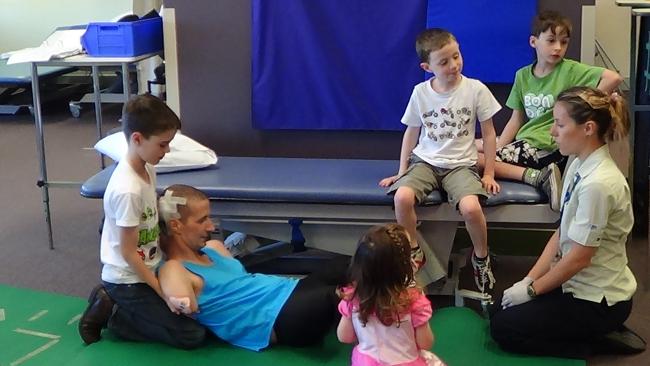
Rehabilitating Matthew has involved mobilising a team of people, including physiotherapist Jacqui Wright. "It was a huge challenge," she says. "I focused on what he did have, which was his core. I always told Matthew exactly what I was doing, because he liked to know what was going on, and we worked together to design sessions based on what he wanted to be able to do.
"We simply had to focus on finding a way to do the most simple things," Wright says. "When we met, he had chronic muscular atrophy and was still very ill. He had to move his stumps, sit up, roll over. We just had to get him moving. We had a few setbacks along the way, which hit Matthew a bit emotionally, such as when his retina detached and he was immobile again, so we had to work around that.


"I actually haven't taken an annual leave day off since I started working with him, which shows you how much I love it. We've spent a lot of time crying, and laughing," she says.
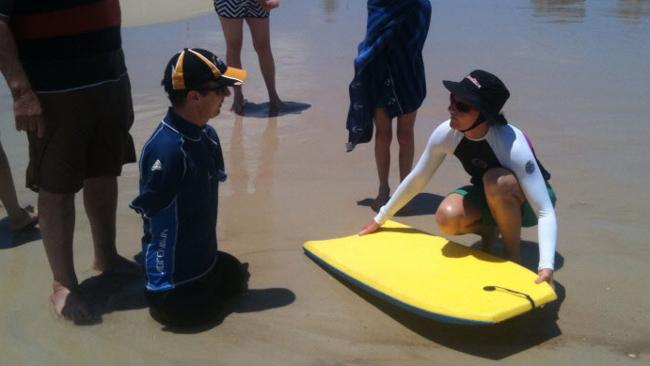
Sessions in rehab with Wright gave Matthew a focus. He set himself specific goals: to be able to sit up, roll over, inch himself up a set of stairs, and finally walk on his new legs, which he achieved earlier this year.
"Jacqui has been incredible," Matthew says. "She knows when I make a particular grunting sound that I'm going to fall, so she leaves me to do [things] on my own until she hears that sound. We make a really good team, because I trust her, and she pushes me. I need that."
Saul Geffen says Matthew's positive attitude has been a huge factor in his rehabilitation. "He's literally one in a million," Geffen says. "Matt has handled an absolutely devastating injury and loss as well as I've seen anybody in my career handle anything. There's something peculiar and admirable in him that I haven't seen before; he has this capacity for self-control and optimism and effort that makes looking after him a pleasure and a privilege."


TEN MONTHS AFTER THE OPERATION, MATTHEW'S finally back at home, where the family is "camping" downstairs. They're waiting until a lift can be fitted to allow access to the upstairs area, which includes the kitchen, main bedroom, and lounge. Matthew hasn't seen his own room since he became ill. The car has been modified, and a ramp has been built at the back of the house to enable access.
Despite the improvised setup, there's a focus on routine. Between ongoing rehabilitation sessions at the Mater as an outpatient, Matthew helps get the kids ready for school and kindy, and tries to figure out ways to do things such as send emails with voice-activated software. He helps with homework and supervises cricket matches in the back yard. "It's important that he's around. His being here makes a difference to the children," Diane says. "While he was in hospital we would visit every afternoon, and we were very lucky that the kids could have sleepovers at rehab. The kids have always seemed to handle things well, but it's really been since he's come home that we've noticed how different they are. Ben, for example, had become a little withdrawn, but he's got his sparkle back now.
"We worry a little that their childhood has been taken away from them in a way, because they have to do more around the house to help. Our boys probably have more responsibility than they should have, but that's just the way things are.
"The children are proud of him. Will took Matthew to school as his 'show and tell' recently. He got Matthew to walk around on the floor, and it was really interesting to hear the story from Will's perspective. We got lots of questions, and the children in class were just wonderful."


MATTHEW'S DAUGHTER EMILY WANTS HIM TO play a game. "Hold out your fingers, Daddy," she says.
"But Emily, I don't have any fingers," Matthew reminds her.
Hmm. She thinks for a moment. "Okay, then. Hold out your hands."
"But Emily, I don't have any hands."
Another silence. "Okay, then. We'll play something else later."
At 3, Emily seems unfazed by her father's new body, and doesn't seem to notice what he can't do. She paints and draws with brushes and pens in her mouth, and when giving Matthew a cuddle, his arm stump is perfect for tickling her between her shoulderblades.
Unlike the boys, she will never know her father any other way.
While obviously some days are hard, Matthew says there is never a time when he regrets his family's decision. He has never been on antidepressants, and decided to take himself off painkillers early in his rehabilitation because he felt they were making his mind unclear. Since then, he's suffered from relentless phantom pain. "The ongoing pain level is around three or four out of ten," he says. "But it's all relative. Even squeezing a pimple might be a seven or eight for some."


He's conscious that he's become a benchmark for others who, once they see him, view themselves as lucky. "There was a guy in rehab who had lost part of his lower limb. At the time, I was still walking around on my bottom, and he told me that he liked it when I came into the gym because every time he looked at me, he felt so lucky. And that's fine that he felt that. I don't hold judgments against anyone. It's just human nature that people might want to stare at me or use me as a benchmark for how lucky they are. That's all okay."
Does Diane think the day will come that Matthew gives up? "No, I don't," she says, without hesitation. "He has too much to live for. While I stay healthy, and he has the kids to be involved with, then it won't happen. Matthew's very clear about what he wants for the next ten to 15 years, which is to be as involved with the kids as he can be. After that, it will be back to just the two of us.
"Life's difficult, but it's the new normal. It is what it is, and we make the best of it. We have had amazing support from family, friends and people we've never met. For example, there are 65 families at the local Catholic school, where the boys go, who are on a dinner roster. I can't believe that people have been so willing to fit us into their busy lives, but it has made a big impact, and I'm so very grateful."
Diane says she always thought the odds would fall in Matthew's favour. "When the doctors told me he had a 50 per cent chance to live or die, I thought he'd be in the 50 per cent that lived. And then when the numbers started to fall, I still thought he would be the one to be okay. Even when it was at one per cent chance of survival, I really did think he would be the one per cent."
She says she doesn't see him as disabled. None of the family does. "Clearly I am disabled," he says. "But I still get a shock when I look in the mirror and wonder who that guy is staring back at me. I just don't feel it, except when someone forgets to feed me." He laughs.
This month, Matthew will have his first operations to graft metal to bone on his arms and legs. He'll be the first in the world to have the procedure, known as osseo-integration, done on all four limbs. While he's not looking forward to more surgery, the results, if they work, will enable him to "clip" on limbs. When he gets his legs done, he will be able to stand without issues with sockets, which are problematic for him, given the lack of length between the end of his stump and his hips


While he is hopeful of being able to ride a bike and maintain his fitness, for now, Matthew says he's looking for functionality that will allow him to be more independent. "Saul [Geffen] told me how difficult prosthetic arms would be to use, and in retrospect, he was right," he says, referring to his current prosthetic "hooks", which require assistance to buckle them on and significant physical coordination to manoeuvre. "I find them extremely tiring, and have to weigh up every day whether it's worth the effort for what I'm trying to achieve. I have two very simple goals. One is to feed myself, and the other is to be able to be independent in toileting."
He's done his research. "It's not a case of simply going out there and getting the best technology available," he says. "It's a matter of identifying what I really need to do, and finding the prosthetics that will help me do that, even if that technology is a bit more simple."
The costs of acquiring functionality in prosthetics are staggering. One full set of prosthetics for mobility in Matthew's case will set him back up to $500,000. They will need replacing after five years. He's just turned 40. "I now understand what it's like to be disabled and the battle to get support," he says. He falls between the cracks in terms of funding because he didn't receive his amputations as a result of a work-related incident or car accident.


"I'm excited about the future prospects with the NDIS as this gap should be closed. For me, the real battle will be finding a way to fund the prosthetics I need over a long period of time."
To date, Matthew's new wheelchair, lift at home, and other modifications have cost more than $100,000, and he has received great support from his former colleagues at Origin Energy and from throughout the energy and resources sector who have raised funds. A foundation has also been established to predominantly assist with medical costs and prosthetics. "I'm very grateful to everyone. I am fortunate to have been given an opportunity to experience the humanity that exists within community. From family to friends to strangers, I have been amazed at the level of support for not only me but for Di and the kids," Matthew says.
"I've been very lucky, actually," he adds. "I've had the opportunity to stop and think for the first time in my life. It was an extreme way to do it, but I've never been one to sit around. Now I have no choice, and I've been able to reflect on what's really important and to think about what makes me happy."


Does he ever feel like just not getting out of bed? "No. Diane sometimes tells me that if I'm sore I should just stay in bed, but if I did that, then I would actually never get up, and it's worth getting up. Every day, no matter how small it is, there is always something worth being alive for.
"Before this, I thought I had the best life and I was happy and loved. Although life may have changed, the most important thing remains the same. I am loved and I am happy."

How to be a happy, successful power couple

TV couple Chris Bath and Jim Wilson's tips on enjoying a busy life
The two juggle high profile jobs, family, and charity commitments
They say their biggest secret is love and respect for each other


THEY'RE the media powerhouse who hate being called a power couple.
It seems Chris Bath and husband Jim Wilson have it all - high-profile careers, happy family lives and enough time to support the charities close to their hearts. While there's no such thing as an average day, they’ve discovered that The Beatles were right:  all you need is love - the rest can wait.
Seven News Sydney presenter and host of Sunday Night Chris Bath married Seven sports reporter Jim Wilson last year after a three year romance, and say raising two children and working full time has its challenges – but they wouldn't have it any other way.

"I fantasise about 'an average day', but am slightly torn about how lucky I am not to have one," Bath tells news.com.au. "The closest our manic household gets to average involves early morning exercise before school lunch-making duties."

"I had to get over not being a morning person to marry having kids and a career, so most mornings I haul myself out of bed before sun-up to stay fit.

"Once mummy duties are sorted, and mandatory coffee fix delivered, some days there is mid-morning exercise too.

"Depending on my marketing, promos, charity and Sunday Night commitments, I usually arrive at Martin Place around noon, head into makeup, then the newsroom and studio for updates and prep for the 6pm bulletin."

She admits that maintaining such prominent, public careers is tough, but working in the same industry means a mutual understanding of its fast-paced, often last-minute nature.
"We still manage to spend plenty of time together as a family, sometimes an extended modern family," Bath says. "Most weekends, we'll be watching one or both boys from the sidelines, along with my former partner Denis and his partner Julia - it's a super-sized cheer squad!"


The self-confessed technically challenged pair have recently synched their diaries – and say the results have provided regular bouts of comic relief.

"The physical act of juggling our diaries is hilarious, Bath says. "Luddites both, we recently acquired an iPhone and the supposed ability to 'share' diaries."

"Our technical ineptitude has caused untold carnage to our schedules. 

"If we have conflicting commitments, we holler for a friend / aunt / nanna / my former partner Denis, or toss a coin to see who wins."

Spare time for the sports-mad family is spent 'watching balls be shunted around a multitude of sporting arenas' – as well as bird watching, which means never leaving the house without a pair of binoculars.

"I am obsessed with birds of prey and to see a Wedgetail Eagle or a Hawk is completely left field, but a complete escape," says Wilson. "Bathie introduced me through her son Darcy and I am hooked – the sports boofhead who loves bird watching, dear oh dear!"

His never-average day usually involves exercise or Sunrise first thing followed by a 9.30am production meeting, setting up bulletins at 11.30am, 4.30pm and 6pm, and then home for a debrief with Chris around 8pm.

"Usually over a glass of vino – red, of course - that’s my favourite time of the day," Wilson says. "And then there are the charities we’re involved in - Police Legacy, Cancer Council, Nelune Foundation, Kookaburra Kids, Very Special Kids, but more than anything, helping raise funds for research into finding a cure for brain cancer, the biggest cancer killer for people under the age of 39 and children under ten."

"I love living life with Chris. She’s a can do person with a passion for living and for what we do professionally."
Their tips on how to be a happy, successful power couple:
• Switch off for down time. Pick up the footy and go for a kick with the kids – and shut off the mobiles and email to make the most of quality family time.

• Be ever the optimist. "Our lives are pretty shambolic but we are glorious optimists and find that not having any hard and fast rules, except showing our kids we love them as much as we can, giving life everything we've got and occasionally saying no, means you can have your career, family, happiness, cake - and eat it too," Bath says.

• Respect each other’s passions. "In the words of the Beatles - all you need is love, and we have a tonne of that. Love and a genuine respect for each other makes a world of difference."

• Ask for help. Family and friends are a great support and love to help when needed. Make the most of their willingness to help juggle the load.

•Have fun. "We are busy and it’s manic, but you’ve got to go hard and enjoy life," Wilson says. "Power couple is so far back of mind, we do the gig because we have a passion for news and live television. We never signed up for power or money, but we are so lucky to be able to get up every day knowing each day is different and stimulating."

Turkish activists ignore appeals to end protest

Protesters have agreed to press on with their 2-week-long sit-in at an Istanbul park, despite government appeals and warnings for the standoff with authorities to end, an activist said Saturday.
Tayfun Kahraman made the comment to The Associated Press after a series of discussions among the protesters in Gezi Park to decide on their next move.
He was one of two activists in Taksim Solidarity, an umbrella group of protest movements, who had met with Prime Minister Recep Tayyip Erdogan on Friday.
The protesters are angry about government plans to pull down trees and redevelop the park area. An initial sit-in drew a forceful police response on May 31, setting off a wave of protests — Turkey's biggest in decades.
Saturday's announcement is likely to return the spotlight on Erdogan's government, which in recent days offered to defer to a court ruling on the legality of the redevelopment plan and possibly hold a referendum on it. But on Thursday, he issued a "final" warning that the protesters must leave the park.
In Ankara, police on Saturday confiscated tents and blankets from protesters who had spent the night in Kugulu Park in solidarity with activists staging a sit-in in Istanbul's Gezi Park. Police also used tear gas and water cannons.
For more than two weeks, Turkish police have been clashing with protesters who claim Prime Minister Recep Tayyip Erdogan is turning into a dictator.
Five people have died and thousands have been injured since the protests began.

Australians waste $25 billion on card interest, smokes, unused food

AUSTRALIANS are frittering away $25 billion a year.
The leading form of waste is credit cards, at $6.16 billion, based on us paying an average of 17.15 per cent interest on nearly $36 billion worth of plastic purchases.
Kirsty Lamont, director of finance product comparison website Mozo which produced the research, said credit cards were obscenely expensive form of debt that hurts the poorest households most.
"I was quite shocked that credit cards came out on top a the number-one money waster," Ms Lamont said.
Bank exception fees consume a further $490 million, while $360 million is lost on unused gift cards.
CommSec analysis of new Reserve Bank of Australia data finds the average credit card balance declined by $39 or 1.2 per cent in April to $3218.
"The average credit card balance is down by 3.2 per cent on a year ago, the biggest fall in 19 years of records," CommSec chief economist Craig James said.
Increasingly, consumers were using their own money to make purchases, rather than going in to debt, Mr James said.
Of credit cards attracting interest charges, the average outstanding balance rose by $61 in April to $2355 after falling by $60 in March. The average balance accruing interest is down by 4.7 per cent on 12 months earlier.
It would be falling faster were it not for the fact that credit card interest rates haven't been falling - unlike other types of borrowing.
The worst cards charge 25 per cent interest. The best are less than 10 per cent.
Smokes are second on the Mozo money-waste list. Australians are spending more than $5.5 billion on tobacco products annually.
The next largest culprits are household food waste at $5.20 billion then gambling at $2.57 billion.
Fifth is mobile phone excess charges - $1.5 billion. There are some encouraging signs on this front. Optus recently reported an annualised $97 million decline in revenue raised from data over-runs.
And an Optus spokeswoman said that "we will launch new plans in the coming months which will further address the issue of bill shock."
Household energy waste ($1.43 billion) and traffic fines ($1.3 billion) are next on the list.
ATM charges remain stubbornly high at $600 million.
In 2009 there was a fall after RBA reforms made fees more transparent. But, Ms Lamont said, there hadn't been any decline in the past two years.
"All this spending is avoidable," said Mozo director Kirsty Lamont. "Even if you enjoy the odd flutter on the horses, and feel you can afford it, there's no excuse for paying banks to let you access your own money through ATM fees."
###

Syrian refugee girls being married off to older men,

WITH no end in sight to Syria's conflict, some refugees in Jordan are offering their daughters for early marriage in the hope of securing them protection as they face growing economic pressure.
Syrian refugee Abu Mohammad says he reluctantly opted to marry off his teenage daughter to a rich 40-year-old Saudi man, hoping to give her a better life and ease his family's financial hardships.
"It was the last thing I wanted to do," Abu Mohammad, 50, told AFP outside his tent at the northern Zaatari refugee camp, home to more than 160,000 Syrians - equal in size to what would be Jordan's fifth-largest city.
"This big prison we live in. It's unbearable," said Abu Mohammad.
The father-of-six said that his daughter's Saudi husband "promised to help us until the crisis ends and we go home," after the marriage three months ago.
"God knows when this is going to happen," he said.
Dominique Hyde, representative of the United Nations Children's Fund (UNICEF)in Jordan, said that it was not clear how widely spread early marriages were, but that there were signs it was taking place.

"Information gathered during assessments and monitoring visits do reveal incidents of forced and early marriage," she said.
"Forced and early marriage is a human rights and a public health problem."
According to Jordanian Interior Minister Hussein Majali, the authorities have recorded 1029 marriages between Jordanian men and Syrian women since refugees started to flee to the kingdom in 2011.
"Non-Jordanian men have married 331 Syrian women. These figures are within normal range," Mr Majali said.
Jordan says it is hosting at least 500,000 Syrians. More than 70 per cent of the refugees are women and children, according to the UN figures.
"Jordanians and other Arabs frequently come to ask me about Syrian refugee women to marry," said Fares Hosha, a 42-year-old former post office employee who now owns a shop selling household appliances
.
"Two men from outside Zaatari recently asked the same question. One customer told them he has two daughters. The three left the shop together and I don't know what happened later."
Mr Hosha thought that refugees accept such "urgent unconditional marriages because they fear the unknown and want to make sure their daughters are safe."
'Hidden slavery and sex trade'
Said's daughters, aged 15 and 16, got married a month ago.
"I am jobless, paraplegic and I cannot support my family," said the father-of-10.
"What can I do? The camp is a dangerous place and I feared for my daughters. I felt marriage was the solution."
Jordanian law allows girls under the age of 18 to marry with court approval.
If the court rules the marriage is in the girl's best interests, she may marry as young as 15, according to UNICEF, which encourages courts to uphold the minimum legal age of marriage at 18 for boys and girls.
Zayed Hammad, head of the Ketab and Sunna Society, which provides aid to tens of thousands of refugees, said his charity receives dozens of requests from men to help them find brides in Zaatari.
"We are a relief group and we want to focus on our job. We do not want to be involved in this issue, which could create problems," he said.
On the main street in Zaatari, Abu Ahmad opened a wedding shop six months ago.
"When I came here, I thought that opening the shop was a good idea," the 40-year-old bearded man said, as a couple looked at wedding dresses. They refused to talk to AFP.
"Each day I rent at least one wedding dress for around 20 Jordanian dinars ($30)."
"In all emergencies we know that women and girls are at increased risk of exploitation," she said.
"Syrians have reported that though early marriage was common in Syria prior to the crisis there have been changes in practices since their arrival in Jordan. Most notably, wide spousal age gaps."
A group of Syrian activists, calling themselves the National Campaign for the Protection of Syrian Women are trying to fight these marriages, and have set up a Facebook page which has more than 20,000 followers.
"Syrian women are not slaves. We cannot remain silent about such hidden slavery and sex trade," they said on their page.
"Calls for these marriages by Arabs from the Gulf and other regions are motivated by purely sexual instincts."
Some Syrian refugees have defended early marriages.
Former security official Said Hariri, 60, said that early marriages are not unusual.
"In our traditions it is normal that a girl gets married at the age of 16. If a girl is 20 and still single, people will call her a spinster," he said.
"I got married when I was 17. You should understand why some parents decide to marry off their daughters at young age, particularly under our current circumstances."
But Ms Hyde disagrees.
"Whatever the context, such exploitation is preying on the most vulnerable and is not acceptable," she said.